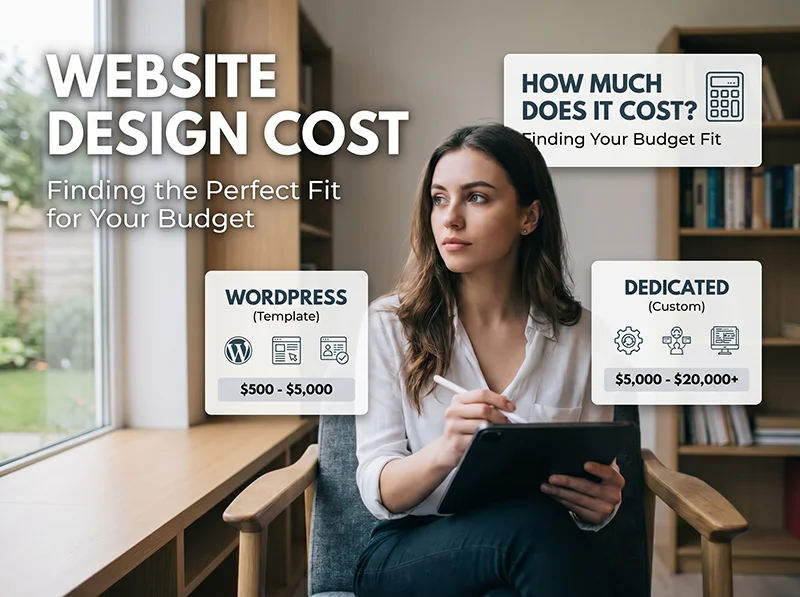
If you've been looking into website design costs, you've probably seen quotes ranging from $500 to $100,000+. The big question is: why such a massive range, and how much should you actually budget?
Here's the honest truth: there's no single price for a website — just like there's no single price for a house. A studio apartment and a custom mansion are both "housing," but their costs aren't remotely comparable. Websites work the same way.
The good news? In this guide, we break down real pricing for 2025, explain exactly what drives costs up or down, and give you a checklist so you never overpay or get stuck with a bad deal.
What Does Website Design Cost in 2025? (Quick Answer)
In 2025, professional website design typically costs between $2,000 and $50,000+, depending on the type of site, level of design, and features required. Small business sites start around $2,000–$10,000, mid-range professional sites fall in $10,000–$30,000, and enterprise-level or custom web applications can exceed $50,000–$100,000+.
But to understand what you're really paying for — and to avoid overpaying — let's break down the key factors.
Why Does Website Design Cost Vary So Much? (6 Key Factors)
Understanding these factors helps you compare quotes apples-to-apples and allocate your budget wisely.
1. Type and Purpose of the Website (The #1 Cost Driver)
Not all websites are built the same. Here's how type affects cost:
| Website Type | What It Involves | Typical Cost Range |
|---|---|---|
| Brochure / Simple Business Site | A few pages, contact form, basic info | $2,000 – $8,000 |
| Professional Business Site | Custom design, landing pages, SEO setup, blog | $8,000 – $25,000 |
| E-commerce Store | Product catalog, cart, payment gateway, inventory | $10,000 – $50,000 |
| Web Application / Portal | User roles, dashboards, complex workflows | $30,000 – $100,000+ |
| Custom Enterprise Platform | Built from scratch, integrations, scalability | $50,000 – $500,000+ |
Key takeaway: The more complex the functionality, the higher the cost. A five-page brochure site and a full e-commerce platform with thousands of products are completely different projects.
2. Template vs. Custom Design
This is one of the biggest cost variables:
Template-based design: Faster and cheaper ($2,000–$10,000), but your site may look similar to thousands of others. Limited customization and scalability.
Custom UI/UX design: Built specifically for your brand, audience, and goals ($10,000–$50,000+). Higher upfront cost, but delivers a unique experience that builds trust and converts visitors into customers.
Pro tip: Even if you use a CMS like WordPress, investing in a custom-designed theme or heavy customization can set you apart from competitors using the same off-the-shelf templates.
3. Design Quality and User Experience (UI/UX)
Two websites can both run on WordPress, but one might be a basic five-page template while the other is a conversion-optimized machine with:
- Clear user journeys and navigation
- Strategically placed calls-to-action (CTAs)
- Optimized landing pages
- Trust signals (testimonials, case studies, security badges)
- Mobile-first responsive design
The difference? The second site turns visitors into customers. That's where the real value — and the price difference — lies.
4. Features and Technical Integrations
Every feature you add increases cost. Common cost-adders include:
- Multi-language support
- Advanced search and filtering
- CRM / accounting / inventory integrations
- User role management (admin, editor, customer portals)
- Booking or reservation systems
- Payment gateway setup (Stripe, PayPal, etc.)
- API connections to third-party tools
- Real-time notifications or live chat
Rule of thumb: Each significant integration typically adds $1,000–$5,000+ depending on complexity.
5. SEO and Performance Optimization
A website built with SEO and speed in mind from day one will cost slightly more upfront, but it pays for itself quickly:
- Technical SEO: Clean URL structure, schema markup, XML sitemaps, proper heading hierarchy
- Core Web Vitals: Fast loading, responsive layout, minimal layout shift
- Image optimization: WebP format, lazy loading, proper sizing
- Security: SSL, firewalls, regular updates
Think of it this way: SEO-optimized design isn't an expense — it's an investment that reduces your ongoing advertising costs and drives organic traffic for years.
6. Agency vs. Freelancer vs. In-House
| Option | Pros | Cons | Typical Cost |
|---|---|---|---|
| Freelancer | Lower cost, flexible | Less accountability, limited scope | $2,000 – $15,000 |
| Small Agency (2–10 people) | Balanced cost & quality, team expertise | May have longer timelines | $8,000 – $40,000 |
| Established Agency (10+) | Full team, processes, ongoing support | Higher cost, slower for small projects | $15,000 – $100,000+ |
| In-House Developer | Full control, immediate access | Salary + benefits + tools costs | $60,000 – $120,000/year |
Complete Website Design Cost Breakdown (2025 Pricing Guide)
Here's a realistic breakdown of what different types of projects cost in 2025:
| Project Type | Price Range | Best For | Example |
|---|---|---|---|
| Simple Business Site (Template) | $2,000 – $8,000 | Startups, local businesses, freelancers | Local plumber's website |
| Professional Business Site (Semi-Custom) | $8,000 – $25,000 | Growing businesses needing lead generation | Law firm, dental practice |
| E-commerce Store (Standard) | $10,000 – $35,000 | Online stores with moderate product catalogs | Clothing, cosmetics, home goods |
| E-commerce Store (Advanced) | $35,000 – $75,000 | Brands with complex inventory, multiple warehouses | Multi-location retail brand |
| Web Application / Portal | $50,000 – $150,000 | SaaS products, membership platforms, dashboards | Online learning platform |
| Custom Enterprise Platform | $100,000 – $500,000+ | Large organizations, unique business logic | Healthcare portal, fintech app |
Quick Decision Guide
- Just starting out? → Simple business site ($2K–$8K)
- Need leads from Google? → Professional business site ($8K–$25K)
- Selling products online? → E-commerce store ($10K–$75K)
- Building a unique product? → Web application or custom platform ($50K+)
Hidden Website Design Costs You Need to Know Before Signing a Contract
One of the biggest reasons quotes vary so wildly is that some agencies include these costs in their price, while others list them separately:
Recurring Costs (Often Overlooked)
| Cost Item | Typical Price | Frequency |
|---|---|---|
| Domain name | $10 – $50 | Annual |
| Web hosting | $100 – $500+ | Monthly/Annual |
| SSL certificate | $0 – $200 | Annual (many hosts include free SSL) |
| CMS/plugin licenses | $0 – $500+ | Annual (some premium plugins renew yearly) |
| Website maintenance & support | $50 – $500+ | Monthly |
| Ongoing SEO | $500 – $5,000+ | Monthly |
| Content creation | $100 – $1,000+ per page | Per project |
| Email marketing tools | $20 – $200+ | Monthly |
One-Time Costs That Are Sometimes Separate
- Professional copywriting
- Stock photography or custom photography
- Logo design
- Brand identity / style guide
- Video production
- Third-party software setup
Important: Always ask your web designer for a written scope of work that clearly states what's included and what's not. This single step prevents 90% of budget surprises.
WordPress vs. Custom Coding: Which Is Right for You?
This is one of the most common questions, and the answer depends entirely on your needs:
WordPress (or Similar CMS) Is Best When:
✅ You need a standard business or e-commerce site
✅ You want to launch quickly
✅ Budget is a primary concern
✅ You don't have highly unusual or complex requirements
✅ You want to manage content yourself without a developer
Popular CMS options: WordPress (largest ecosystem), Shopify (e-commerce focused), Webflow (design-focused), Joomla, Drupal
Custom Coding Is Best When:
✅ Your business logic is unique and can't be replicated with existing plugins
✅ You need multiple user roles and complex workflows
✅ You're building a SaaS product or web application
✅ You need to scale significantly and require optimized architecture
✅ Performance and security requirements are enterprise-grade
Important Recommendation
Even if you choose WordPress or another CMS, invest in custom UI design or at least serious theme customization. This ensures your site doesn't look like thousands of others and delivers a better user experience — which directly impacts conversions and revenue.
The Expensive Mistake Almost Everyone Makes
The #1 mistake businesses make is choosing based solely on the lowest price. Here's what typically happens:
- Month 1: Site launches. It looks "okay."
- Month 2–3: You realize the site is slow, isn't showing up on Google, and has security vulnerabilities.
- Month 4–6: Customers complain about broken features on mobile. You can't add new functionality without major rework.
- Month 6–12: You're forced to rebuild from scratch — paying twice.
Your website is your digital storefront. Treat it as an investment in your business infrastructure, not a commodity to be minimized.
How to Tell If a Website Design Quote Is Fair (6-Point Checklist)
Instead of just comparing dollar amounts, ask these questions:
✅ The Fair Price Checklist
1. What exactly is included in this price?
→ Design, development, content upload, training, security setup, technical SEO — get it in writing.
2. Is it a custom design or a pre-made template?
→ If template, is the license properly purchased? If custom, how many revision rounds are included?
3. What about SEO and page speed?
→ Ask specifically: URL structure, schema markup, image optimization, mobile responsiveness, Core Web Vitals.
4. What's the post-launch support policy?
→ How many months of free support? What does it cover? What's the response time?
5. Will I own everything?
→ Domain, hosting account, CMS admin access, source files, database — all should be yours.
6. Can I see real, verifiable portfolio examples?
→ Ask for 2–3 similar projects. Check the live sites. Look at speed, design quality, and mobile experience.
Red flag: If a company can't answer these questions clearly and confidently, proceed with caution.
Frequently Asked Questions (FAQ)
How much does it cost to design a website in 2025?
Professional website design costs range from $2,000 to $50,000+ depending on the type of site, design complexity, and features. A simple business site starts around $2,000–$8,000, while a custom web application can cost $50,000–$100,000 or more.
How long does website design take?
A simple business website typically takes 2–4 weeks. An e-commerce store takes 4–12 weeks. Complex web applications or enterprise projects can take 3–12 months depending on scope.
How much does it cost to maintain a website?
Ongoing website maintenance typically costs $50–$500 per month for hosting, security updates, backups, and minor changes. Larger sites with regular content updates and SEO may cost $500–$2,000+ per month.
What's the cheapest way to build a website?
The most affordable option is using a CMS like WordPress with a quality template ($2,000–$5,000 for design and setup). Website builders like Wix or Squarespace offer DIY options for $15–$50/month, but they come with limitations in customization, SEO, and scalability.
What's the difference in cost between a business website and an e-commerce store?
E-commerce stores cost more because they require additional features: product catalogs, shopping cart, payment gateway integration, inventory management, order processing, and security for transactions. Expect to pay 30–50% more than a comparable business site.
Can I start cheap and upgrade later?
Yes, but only if the foundation is solid. Make sure your initial site is built on a scalable platform (like WordPress) with clean code. If the foundation is poor, you may need to rebuild entirely — which costs more than doing it right the first time.
What's the difference between hiring an agency vs. a freelancer?
Agencies typically offer a full team (designer, developer, project manager), established processes, and ongoing support. Freelancers are often cheaper but work alone, which can mean slower delivery and less accountability. Choose based on your project's complexity and your risk tolerance.
Does website design cost include domain and hosting?
Not always. Some agencies include the first year of domain and hosting; others list them separately. Always ask for clarification before signing a contract.
Is SEO included in website design pricing?
Basic technical SEO (site structure, speed optimization, meta tags) is often included. Ongoing SEO (content strategy, link building, keyword optimization) is almost always a separate monthly service.
Final Thoughts: How to Make the Right Decision
Website design cost in 2025 ranges from roughly $2,000 for a simple site to $100,000+ for a custom enterprise platform. The final number depends on:
- Type of website (brochure, e-commerce, application)
- Design approach (template vs. custom)
- Features and integrations required
- Technical quality (SEO, speed, security)
- Ongoing support and maintenance
Before you get quotes, define these 5 things:
- Type of site (business, e-commerce, application)
- Number of pages or products
- Must-have features (payment, booking, CRM, etc.)
- Languages / regions
- Primary goal (leads, sales, brand awareness, user engagement)
The cheapest option isn't always the best — but the most expensive isn't always either. Focus on finding the right fit for your goals, budget, and timeline. A fast, secure, SEO-ready, and scalable website is an investment that pays for itself.


